

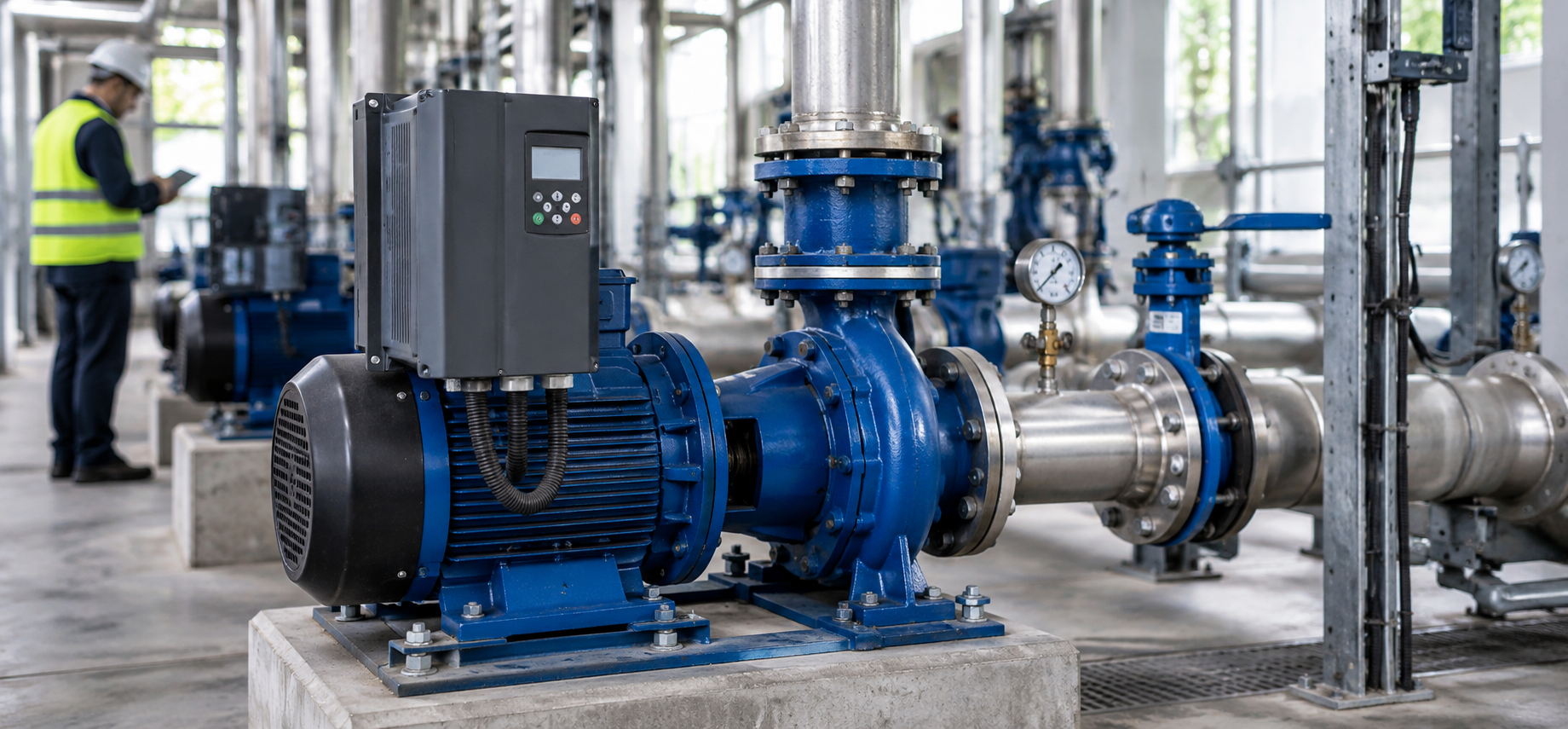
Variable-speed retrofits can look like straightforward motor-and-drive purchases. They are not. The drive changes how a centrifugal pump meets a system curve, so the first procurement question is not which drive to buy. Instead, establish what the present system actually asks the pump to do. Start by recording flow rate, head, suction conditions, control position, and power at ordinary operating states before changing anything.
That record also makes the equipment conversation more concrete. The BBP pump configurations can be discussed as real centrifugal-water-pump categories, including end suction pump, self-priming pump, double suction pump, sludge pump, and trash pump options. It does not, by itself, select a unit. It gives the team a vocabulary for matching a system duty to a pump type.
Begin with the system, not the drive setting
KSB describes the operating point as the relationship between the pump characteristic and the system characteristic. That matters because a speed change shifts the pump response, while the pipework, valves, elevation, and process demand still shape the system response. A retrofit team that starts from a nameplate can miss the point where the existing installation is actually running.
Walk the route the liquid takes. Identify the suction source, static lift or static pressure difference, discharge destination, branch changes, control valves, filters, heat exchangers, and recurring restrictions. Even a clean drawing is not a field measurement. One partly closed isolation valve, a fouled strainer, or a changed process route can matter more than the original design intent.
The pump curve is a practical way to connect those observations. Grundfos explains that a curve relates flow and head, and that impeller geometry and power affect the curve. Use the curve as a question list: at the observed flow rate, what head is being supplied; at that duty, what does the power trend look like; and is suction margin being considered before speed is adjusted?
Separate static head from friction losses
Static head is the portion that does not disappear simply because the pump turns more slowly. In a transfer system, elevation or a pressure difference across the process can remain even when the flow rate falls. Friction loss, by contrast, changes with flow through the line, fittings, valves, and equipment. Treating both as one vague “head requirement” produces an unreliable basis for variable-speed control.
The Hydraulic Institute notes that pump curves include head, power, efficiency, and suction-related information across flow. That supports a simple discipline: capture head and flow together, rather than collecting a pressure reading on one shift and a process estimate later. The pair is what tells the project team whether the system behavior matches the proposed control story.
Field notes should also say where each pressure point was taken and what the process was doing. Gauge pressure near the discharge flange is not a substitute for process-side pressure. If the system contains multiple branches, record the active branch arrangement. Later tests can otherwise look different for reasons that have nothing to do with the drive.
Make partial-load operation visible
The Department of Energy’s pump-systems resources include material on variable-speed pumping and pumping-system performance. The useful lesson for a retrofit is modest: variable speed deserves system-level analysis. It is not a standing promise of reduced energy for every installation, especially when the duty is dominated by static head or when control practice keeps the pump near one operating condition.
Look for the operating states that create the most trouble, not only the state that is easiest to test. A circulation loop may have normal demand, low demand, warm-up, cleaning, and an occasional bypass condition. An end suction pump with a throttled discharge valve at one condition can react very differently from a self-priming pump serving intermittent drawdown.
BBP product categories can help organize that discussion without becoming a performance claim. During a BBP review, the team can distinguish whether the conversation concerns a centrifugal pump for clean water, a self-priming pump where priming behavior matters, or a sludge pump handling a different liquid and solids context. The supplier still needs the confirmed liquid, duty, materials, seal arrangement, and installation details.
Partial-load notes should include what the control system was trying to hold. Pressure control, level control, temperature response, and a manually set speed are different operating stories. They can produce similar readings at one moment, yet they create different risks when demand shifts. State the control intent beside the readings so later reviewers do not have to infer it.
Pay attention to recurring interventions by operators. A bypass opened during a changeover, a valve that is routinely adjusted, or a speed command that is kept above its intended value is evidence about the system. These details are often absent from a drawing. They should be present in the retrofit baseline because they explain why the pump is being asked to work as it does.
Check the impeller, driver, and seal as a set
Each pump curve is tied to a particular pump arrangement. Grundfos notes that the size and shape of the impeller affect the curve. Before a retrofit, confirm the actual impeller, motor, coupling arrangement, and any prior trimming or replacement. Catalogue curves for similar models are starting references, not proof of the installed hydraulic condition.
Mechanical seal behavior belongs in the baseline too. Record leaks, vibration observations, starts and stops, seal-water arrangements where present, and maintenance history. Changing speed may soften a start or alter running speed, but it cannot correct a seal installed for the wrong liquid, a shaft problem, or an operating point that the pump was never meant to hold.
For BBP equipment discussions, keep the product description at the level the current catalogue supports. BBP lists centrifugal-water-pump families such as end suction, self-priming, double suction, sludge, and trash pumps. Selection and retrofit advice should remain conditional on a verified system baseline and the supplier’s application review.
Turn the baseline into an acceptance plan
The baseline should survive the purchase meeting. Put the existing operating states, measured points, instrumentation locations, known restrictions, and unresolved assumptions into the request package. Ask the integrator to state which condition is being controlled, what signal is used, what happens at low flow, and how the pump will be protected if the process changes.
Acceptance should compare like with like. Run the post-retrofit observations under matching process states where practical, then compare the flow rate, head, power, stability, and control response with the baseline. Differences in weather, product, water level, or production schedule should be recorded instead of quietly treated as pump effects.
Acceptance also needs a response for an unexpected result. If observed head, flow rate, or power does not match the proposed behavior, pause the broad savings narrative and check the measurements, valve line-up, impeller record, and system restrictions. Stop there. This prevents a commissioning disagreement from becoming a marketing explanation. Such a mismatch merits a slower review of the process route, current restrictions, observed control action, instrumentation location, valve position, and active branch arrangement before anyone changes the design basis, because a changed production condition can otherwise be mistaken for a drive-related hydraulic result.
Variable-speed retrofits can be sound operating decisions. They earn that status through a measured system picture, an honest view of static head and partial load, and a defined check after commissioning. The drive is a component; the system baseline tells the team whether the component is being asked to do the right job.
Further reading: KSB’s operating-point article and the Hydraulic Institute pump-curve guide are identified in the source comments above.
The post Why Variable-Speed Pump Retrofits Need a System Baseline appeared first on TechBullion.
from TechBullion https://ift.tt/nZH6t9O
ref=da&site=blogger">IFTTT



